Dubai Carbon

Dubai Carbon

The United Arab Emirates, the land mostly known as ‘the country were oil comes from.’ In many peoples perception oil will be pumped out of the ground until the desert has evaporated and solar panels will remain science-fiction. During my time in the UAE I discovered that this is definitely not the case and many efforts are made to switch to renewable energy sources and have I seen more initiatives who find it highly important to reduces their carbon footprint.

To hear more about how sustainable the country is and efforts that will be made in the future I contacted Dubai Carbon, a think-tank in environmental econmocis which is a co-operation between the Dubai Supreme Council of Energy and the United Nations Development Programme (UNDP). In 2011 this agreement was signed by H.H. Sheikh Mohammed bin Rashid Al Maktoum, Vice President and Prime Minister of the UAE and Ruler of Dubai, H.H. Sheikh Hamdan bin Mohammed bin Rashid Al Maktoum, Crown Prince of Dubai and UN Secretary General Ban ki-Moon. Dubai Carbon’s stakeholders are both public and private and DC helps them include efficiency and best practices within environmental, social and the generic sustainability value chain in their business model.

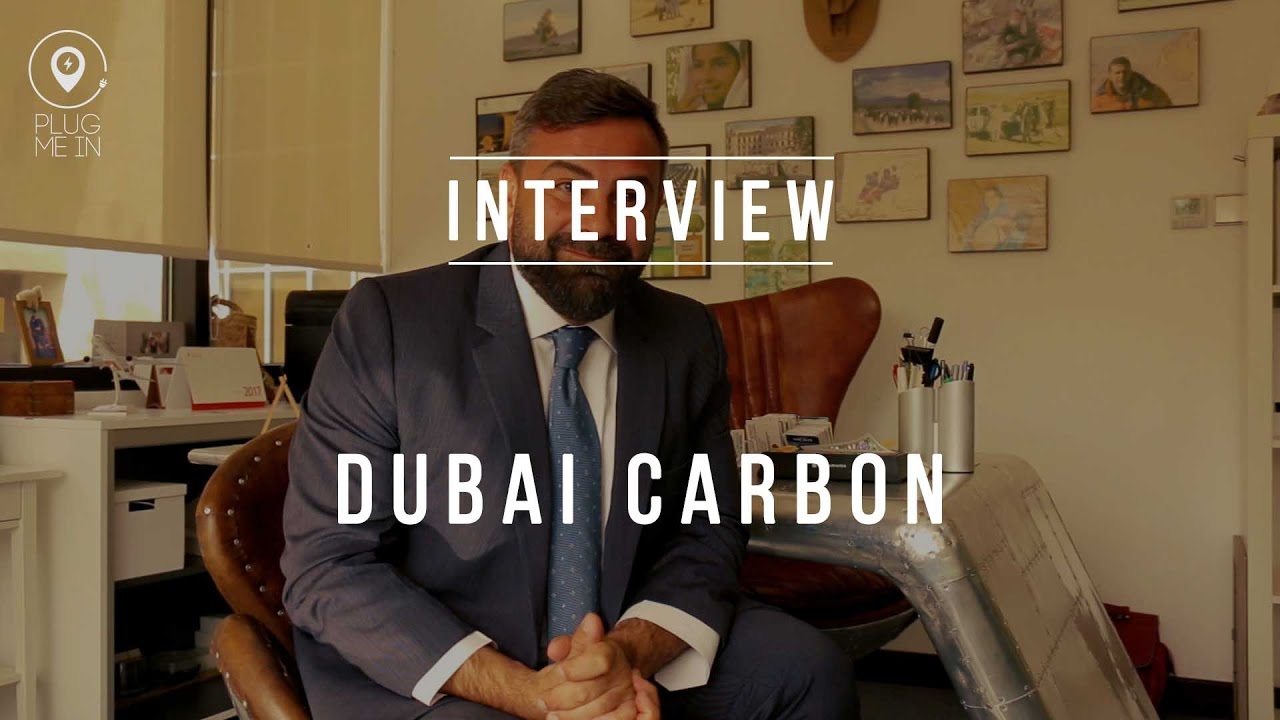
I interviewed Dubai Carbon’s CEO Ivano Iannelli, who build up a reputation as one of the world’s foremost expert in the fields of sustainability and carbon emissions management.

Q. In a country not well-known for sustainable efforts, how was Dubai Carbon founded?
Mr. Iannelli:
“There is a very large culture of excellence in this country and even though it might not be perceived as such from the outside, the sustainability credentials for the UAE are actually extremely high. There is a willingness to excel, there is a willingness to be best in class, there is a culture of corporate excellence. They wouldn’t go for the inefficiënt approach but they want to make sure the resources are looked upon for their preciousness, for their value. Not only in short-term but also a long term-approach.” Referring to Sheik Mohammed bin Rashid Al Maktoum’s visionary ideas on the country.

Q. How is the mix of energy in the UAE?
Mr. Iannelli: 
“At the moment we have a very minimal solar power but this is only because the large PV-plants will be commissioned in a span of a few months. Dubai has the largest single side PV-plant in the world and has been gradually growing simply because of its success. In a span of 2 years Dubai broke 2 times the world record for lowest tariff for solar, bringing the price down to 2.9 cents, Adu Dhabi even managed to bring it down to 2.4 cents per kWh. These are signs that times are changing and that renewables are becoming cost-effective.”

“When you look at the energy mix you can not rely on only wind or solar but you need to have a balanced approach and Dubai is doing exactly this. By 2050 we will scale up renewables to 75% together with all the other sources who are being tested and launched as we speak.”

“In the current situation we have a very efficient gas-powered combined cycle power plant. Dubai produces power at 0.42 tons of CO2 per MWh produced, the next in-line is Germany, producing at 0.39 tons of CO2 per MWh but Germany add a very large amount of renewables in their mix. To give you an idea of how efficient the fossil fuel based energy production in Dubai is compared to the globe.

Mr. Ianelli add thats the misconception of Dubai being inneficient or not sustainable is very superficial. “If people understand what this city has achieved within a short span of time than they would be able to understand what there is. First of all there is a fantastic playing field of sustainability because not a single played in this city has not looked at sustainability in their scope of work. The second element of it is that to do what Dubai has done, they need to be highly efficient, they need to be very pragmatic in the way they use resources because they would otherwise upset the normally economic close of supply and demand. So to build this much you don’t put too much strain on the market because prices would escalate. So this balance what the city has achieved in economic term is a fantastic example of economic success in terms of sustainability, that should be looked upon and replicated whenever possible.

During my journey I started to wonder if it’s possible for a country to become carbon-neutral, and is it necessary? I saw Norway were they produce 98% of their energy from renewables but still have a lot of offset because of their richness in oil. I heard from South-American countries who generate their power 100% from renewables.

Q. Can Dubai or any other country achieve to be carbon-neutral?
Mr. Iannelli: “I don’t think any country in the world can achieve carbon-neutrality because there is always a resource consumption, and we don’t want carbon-neutrality as it will alter the balance of the eco-system. What we want is to run within the global CO2 budget. There are natural sorts of CO2 things in the world, soil, trees, water etc. So we don’t need to actually achieve carbon-neutrality. What we have is a global-warming potential which equates all sorts of greenhouse-gasses to CO2 according to the time it takes the globe to metabolize them. In the 21st century the number is 1466 gigatons of CO2. What we need to reach is that countries not consume more than the world can metabolize. Currently the world is consuming at an alarming rate. The herd offshoot day (the days we consumed all the resources for the year) last year was on September 26. So as an impact we don’t need to achieve carbon-neutrality, we just need to stat within the carbon-budget that we have been given.

Electric Vehicles

Of course I needed to know how electric cars fit in to the bigger picture. Dubai Electricity and Water Authority (DEWA) is also involved in Dubai Carbon and has place already 100 charging stations in Dubai and just announced the second phase of stations which will double the amount. With only 57 users so far they definitely see a big future for electric mobility.

Mr. Iannelli: “The vehicles that are being brought here are being stresstest against a different kind of environment. Dubai as a city is stretched along the coast it’s a lot less dense and longer distances are needed to be covered by EV’s.


Full interview
Watch the full interview here
Dubai CarbonDubai Carbon


UN City (United Nations)

UN City

The United Nations doesn’t need much introduction. The organization is maintaining international peace and security, developing friendly relations among nations and promoting social progress, better living standards and human rights since 1945.

In Copenhagen many different branches of the UN such as UNHCR, Unicef and WHO where spread over the city. After the Millennium Summit it was decided that all ten in Copenhagen based UN agencies where moved into one compound. This will not only obtain savings on economic scale but also facilitate the co-operation between the different agencies. The plans where formed in 2002, in 2005 the location Marmormolen was decided and in 2013 UN City was put into operation. The location houses around 1.300 employees from 100 different nationalities.
A bit further, in the container port, a second building (Campus 2) was constructed. This is UNICEF’s new state of the art high bay warehouse and is currently the largest humanitarian warehouse in the world.

Sustainable building

What got my interest in this building is that it received many awards for their sustainable efforts. Amongst the awards are the European Commission’s Green Building Award for New Buildings and the platinum Leadership in Energy and Environmental Design (LEED) certification which is one of the most popular green building certification programs used worldwide. UN City is one the most sustainable buildings of it’s kind in Scandinavia. Because of their involvement with LEED they have looked at sustainability since the drawings were being made and they looked at 5 environmental categories: Sustainable Sites, Water Efficiency, Energy and Atmosphere, Materials and Resources & Indoor Environmental Quality plus an additional category: Innovation in Design. From this categories I will highlight some of the most interesting ones.


From solar panels to sea water cooling and external metal blinds to regulate light and heat. UN City shows wat can be achieved.
– UN Secretary-General Ban Ki-moon


Water

UN City captures around 3 million liters of rain water each year. This is enough to flush the toilets 5300 times a day. Low-flow taps and toilets reduce the water usage. Combined, the use of innovative taps, toilets and rainwater reduce the consumption of water in the building’s kitchens, toilets and showers by 61%.

Use of natural resources

Sophisticated solar shade’s on the building’s facade can be openend and closed to either trap or reflect heat from the sun. UN City is entirely ventilated with filtered, outside air. Cold sea water is used to cool the building down.
To produce electricity 1.400 solar panels are installed on the roof. The panels produce 297,000 kWh/year, this significantly reduces the electricity needed from the grid.
The roof of the UN City has been coated with a white, recyclable membrane, made from plant-based materials. The environmentally-friendly coating reflects much more sunlight than the usual dark layer.

UN City Solar Panels

Cycling & accessibility  

To reduce pollution from transportation, UN City encourages cycling to work. There are 680 bicycle racks across the site, including 225 which are covered, and a further 115 in the basement. Fifteen showers and changing rooms are also available to freshen up after your ride. To ensure access for everyone, parking spaces for people with disabilities can be found in front of the lobby.

Recycling 

UN City recycles its waste wherever possible. Organic waste from the canteen is pumped through a vacuum system to a container in the basement. This food-based waste is then removed by a company that recycles it for use as fertilizer or to create biogas. Other materials, such as paper, cardboard, glass, plastic and metal, are separated in different bins to be collected and recycled by the City of Copenhagen.

The tour through the building was most interesting. I haven’t been in a building of this size and being it the United Nations was special. It was interesting to learn that a a location of this size can reduce their carbon footprint enormously.

Source: interview with Flemming Johannesen and UN City website


Day 85 | From the UN to Zlatan’s House

Before I departed to Sweden I had one last meeting in Copenhagen, this time at the United Nations. They have their national headquarters in CPH and the building was finished just three years ago. It grabbed my attention because it won many awards and last week in Vejle I was introduced to the company who made the solar panels for this building.

The UN City building is located right next to a river which provides a natural divider, the building’s protection is high. There is a separate entrance for staff and visitors and all your belongings go through a x-ray scanner, just like a airport.

https://www.facebook.com/UNCityCPH/photos/a.382131165263366.1073741830.376734075803075/789187671224378/?type=3&theater

I was welcomed by Flemming Johanessen. He gave me a tour through the building. The building is based on the UN’s global goals for sustainable development. It’s 50% more sustainable then an average office and 30% of it’s electricity comes from the 1.400 solar panels on the roof which produces 297.000KWh annually. A more in-depth recap will follow later on this page.

After the meeting it was time to head to country number nine: Sweden. To get there you need to take a ferry or pass a bridge. Both cost around 50 Euro so the last days I was looking for a solution to get to the other side. Luckily Mads (where I was staying Saturday) had a great idea. He had the BroBizz pass, it’s a small scanner which you place on your window and when you near the tollbooth it scans it and lets you pass. Mads told me that the last time he wanted to cross the bridge it didn’t work, a woman had to come and would scan the pass manually and let him continue. Mads had the idea to give me the pass, when I would be on the other side he would call the operator and tell them he needs a new one. If they would send him a new pass I could keep the pass, if not I would have to send it back.

I crossed the bridge without any problems and arrived in Sweden, literally the first thing I saw when I passed the border was an IKEA, very typical. As they always have free charging spots and WiFi I decided to work there for a bit. Later I would go into Malmö.

Malmö is famous (at least to my knowledge) for only one thing: the birth- and living place of Zlatan Ibrahimovic. At the IKEA I googled his living address and it was very easy to find so I decided to have a look. It was a huge pink mansion right at the beach. According to his biography Zlatan and his wife liked this house so much that they needed to have it. He left a note for the owners “We want your house, you might think this is a joke but I am serious, we will make sure that you are happy”. They offered the 30 million Kronen, which was four times more then it originally cost and they agreed to that.
Unfortunately Zlatan was not at home, they told me he had to play some tournament in France? Haven’t heard about that.

https://www.instagram.com/p/BGW-4S3Eiwj

My sleeping place for tonight was still unsure, I had the other days until Friday fixed but there was not really an offer in the area around Malmö. I posted a message on Facebook to get some help and was waiting for replies. I had one girl who offered me food in Helsingborg so I decided to go to her and make my plan from there.

Maria found me because of a friend in Holland, Annemieke shared a post about plug me in. Maria and Annemieke knew each other from Australia, where they travelled in 2010. Maria is an artist and author. Her paintings are actually really good. She hopes to make a living of this later but also plans to study for more certainty. Maria made chicken for me, chicken is always a good idea.

On the call on Facebook I received many reactions but all of them could either host me later this week or in a place which was not nearby. I had to look for a place where I could charge the car and sleep too. The IKEA seemed like a good option. It was quite and dark there but at 4am they turned on the lights which woke me up, which wasn’t bad as I had the interview with Radio 1 at 4.15am. I found out that I didn’t had service on my phone so I couldn’t receive the call, bad luck, I hope they found a replacement.